

Jon Sobel Reviews Sarah Kirkland Snider – ‘Forward into Light’
ALBUM REVIEW
February 25, 2026
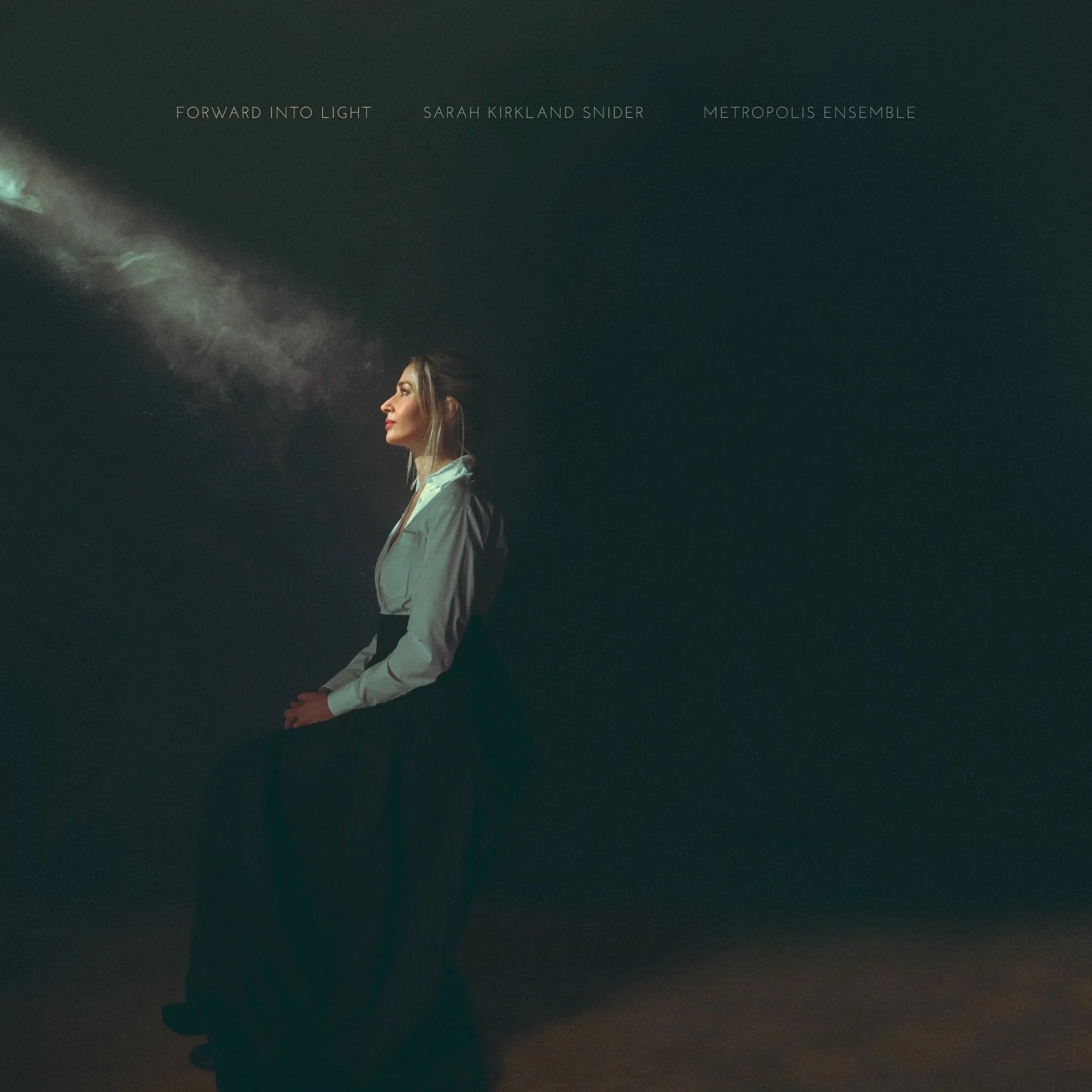
Jon Sobel from Blog Critics reviewed Sarah Kirkland Snider’s new studio album, Forward Into Light, on Nonesuch Records/New Amsterdam Records. Read more »
“Explaining why Arvo Pärt is the most performed of all 20th-century composers, Pärt’s son Michael pointed to “a growing yearning for music with an inner, spiritual depth – music that can speak across cultures and act as a unifying force in an increasingly divided world.”
Those words came to mind as I reflected on the recent work of composer Sarah Kirkland Snider – her triumphant opera Hildegard and before that, her chamber piece for choir and small orchestra Mass for the Endangered – and listened to her new orchestral opus, Forward into Light.
This is the flowing 15-minute effusion that opens and gives its title to a new recording of Snider compositions. “An inner, spiritual depth…a unifying force.” I listen to a lot of contemporary music, much of it (often deliberately) challenging to understand or even listen to. Snider is as innovative as many of her contemporaries, yet I find it hard to imagine anyone disliking her music.
The new album reveals Snider as, among other things, a master orchestral colorist. In Forward into Light (the piece) she creates vidid images, some natural, some fantastical, out of the everyday instruments of the orchestra. A New York Philharmonic commission, it takes as inspiration the women’s suffrage movement, even including a quotation from Dame Ethel Smyth’s “March of the Women” anthem. (You hear it clearly in the next-to-last minute.)
But you don’t need to know any of that to appreciate the depth and sparkle that bear witness to the charged meaning underlying every swell of the strings, tumble of the trumpets, whistle of the winds, tinkle of the piano or harp, and punch of the timpani. The sense of a journey full of surprises coexists with a subtle narrative flow. Above all, there is sheer beauty in Snider’s dynamic wielding of the orchestral voices.
“Drink the Wild Ayre” (2024), originally a string quartet, appears here in an arrangement for harp and strings. A strain of the minimalism of Steve Reich, with harp and strings trading ostinatos, jostles with a harmonic language that draws from both 20th-century American music and the Romantic era. The harp produces some rather startling, almost percussive effects while the strings chip out fragments of melody and build cross-currents of scales.
Eye of Mmenosyne, from the same prolific year for Snider, is a collaboration with visual artist Deborah Johnson that “explores how memory, innovation, and culture refract through the lens of photography.” But the music stands on its own. Each movement has its own emotional tone and musical flavor: spidery (“Ephemera: Fragmented Memory”), and peaceful (“Memento: Defense Against Time”); darkly motile (“Mori: Memory of the Dead”), and fraught (the masterfully arranged “Nostos: War Story” with its sirens and alarums); and so on.
The album finishes with the two-part Something for the Dead, where gigantic edifices of sound alternate with quietly tense passages. The piece epitomizes Snider’s technique of building structures that vibrate and dazzle with simultaneous goings-on without dissipating into the abstract, while within the same piece creating ear-catching, intelligible textures that flower in unexpected dimensions.
Despite its orchestral focus, the album is fully a creature of the studio. Working with the Metropolis Ensemble led by Andrew Cyr, Snider sought to precisely limn “the subtlest orchestration details and tempo changes” by using “intentionally idiosyncratic approaches to isolation and tempo mapping, maximizing control over individual lines without sacrificing musicality or expressivity.” That’s a lot of Latin and Greek words, but the effect is exceptional clarity. One can lose oneself in washes of sound while also identifying individual instruments and sections. It’s exhilarating listening experience.
Bachtrack’s recent annual report showed that 30 of the 250 most performed composers were women in 2025, up from only seven in 2016. Among the 10 most performed living composers are two women, Caroline Shaw and Anna Clyne. A focus on orchestral music might slow the rise of a Sarah Kirkland Snider to that level of popularity in repertoire. But Snider’s music, intriguing and accessible, complex and emotionally gripping, is of the ilk that can have a similar “unifying force” to that of Arvo Pärt, as the response to Hildegard may be suggesting.
The classical music establishment has been taking note: Forward into Light includes commissions from the Detroit Symphony Orchestra and the Rochester Philharmonic as well as the New York Philharmonic. Whether recorded or played live, this music adds significantly to her oeuvre.”
- Jon Sobel