

Stephan Crump
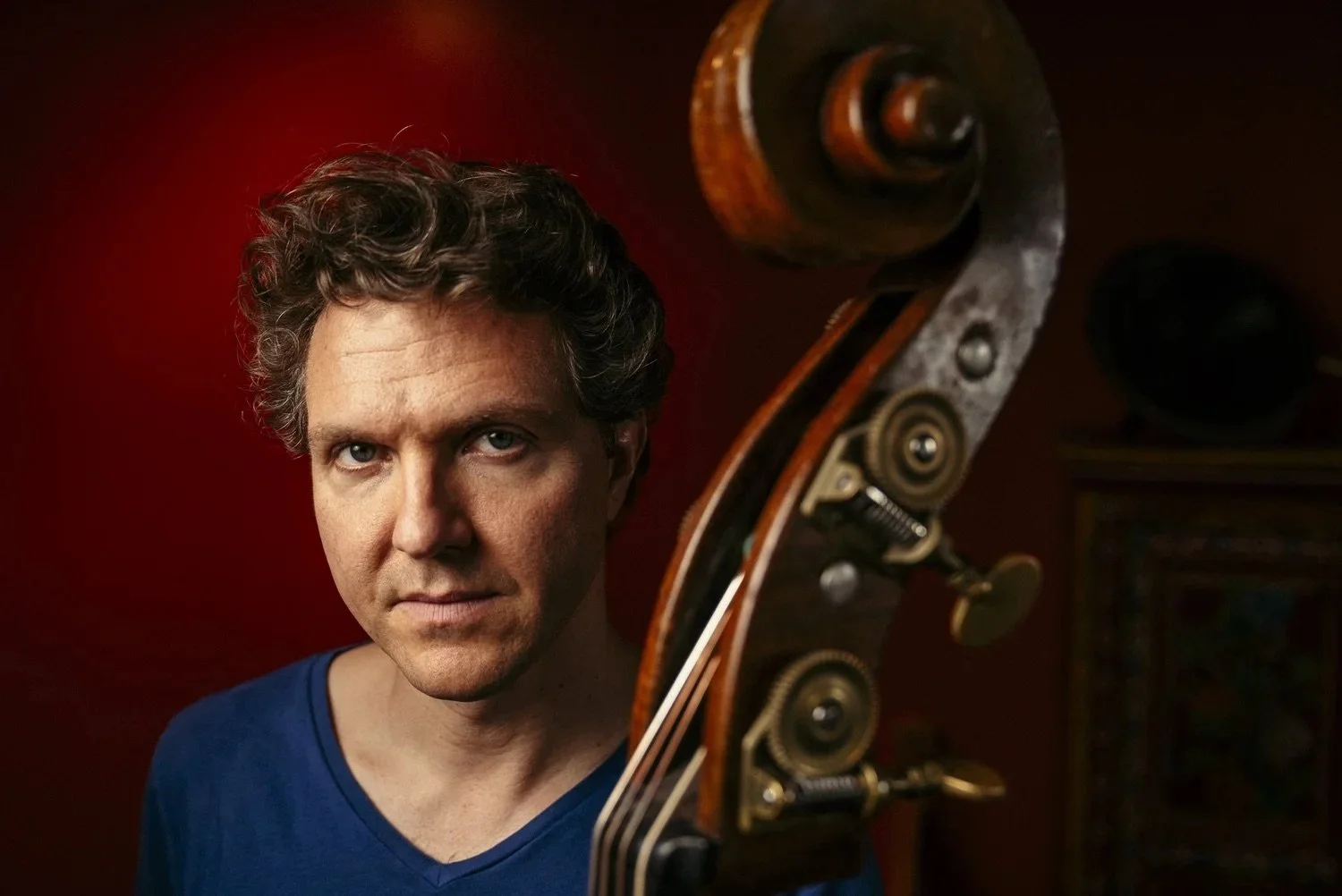
On a recent wintry afternoon in Manhattan, Stephan Crump was doing what he has done countless times in the city—toting his upright bass, clad in a heavy black bag, along the sidewalk, as if he had a baby that was also a bear.
Finding his car, Crump shimmied the instrument through the minivan’s side, climbed into the front seat, exhaled, and then grinned. In less than 24 hours, he would fly to Portland to teach “On Magnetism,” a long-accreting class on connecting more deeply with yourself and others through your instrument, and to play solo at the city’s jazz festival. But he knew he first needed to make the 40-minute trek from Brooklyn to Finlay + Gage, the legendary bass shop in Tribeca, to have his bass adjusted, so that he could make that connection himself. The sound post—that stout wooden dowel inside the bass that keeps it from collapsing on itself, and that the French call l’âme, or the soul—wasn’t sitting quite right.
“It’s so personal, elusive, and mysterious. Yes, it’s a mechanical thing, but it has so much mojo to it. That’s why it’s called ‘the soul,’” Crump explained several days later from Portland, noting that the hassle of the errand had been worth it. The bass felt good in his hands again. “It’s this combination of sound and feel.”
For a quarter-century now, pairing sound and feel have become Crump’s ambit and expertise. A bassist and composer, collaborator and bandleader, Crump has become one of New York’s most steadfast and experienced instrumentalists. He was the anchor of Vijay Iyer’s foundational trio for 20 years, even as he developed a slew of imaginative ensembles of his own—the two-guitar Rosetta Trio, the Borderlands Trio alongside Kris Davis and Eric McPherson, the Secret Keeper duo with Mary Halvorson, just to sample. In all of these contexts, the act of bringing the rest of his life to the bass—the trauma and hope, the frustration and delight—remains Crump’s primary motivation. It is, if you will, the soul of his playing.
“All art is an expression of the artist’s presence in that moment. Musicians need our evolving physical capabilities on the instrument and technical knowledge—how notes interact harmonically and melodically, transcribing our heroes, learning all that,” Crump said. “But in the act of making music, we need to allow that stuff to fall away, to not impose it on the music, to relinquish our defenses. We are sculpting energy as we make music, shaping magnetism.”
